
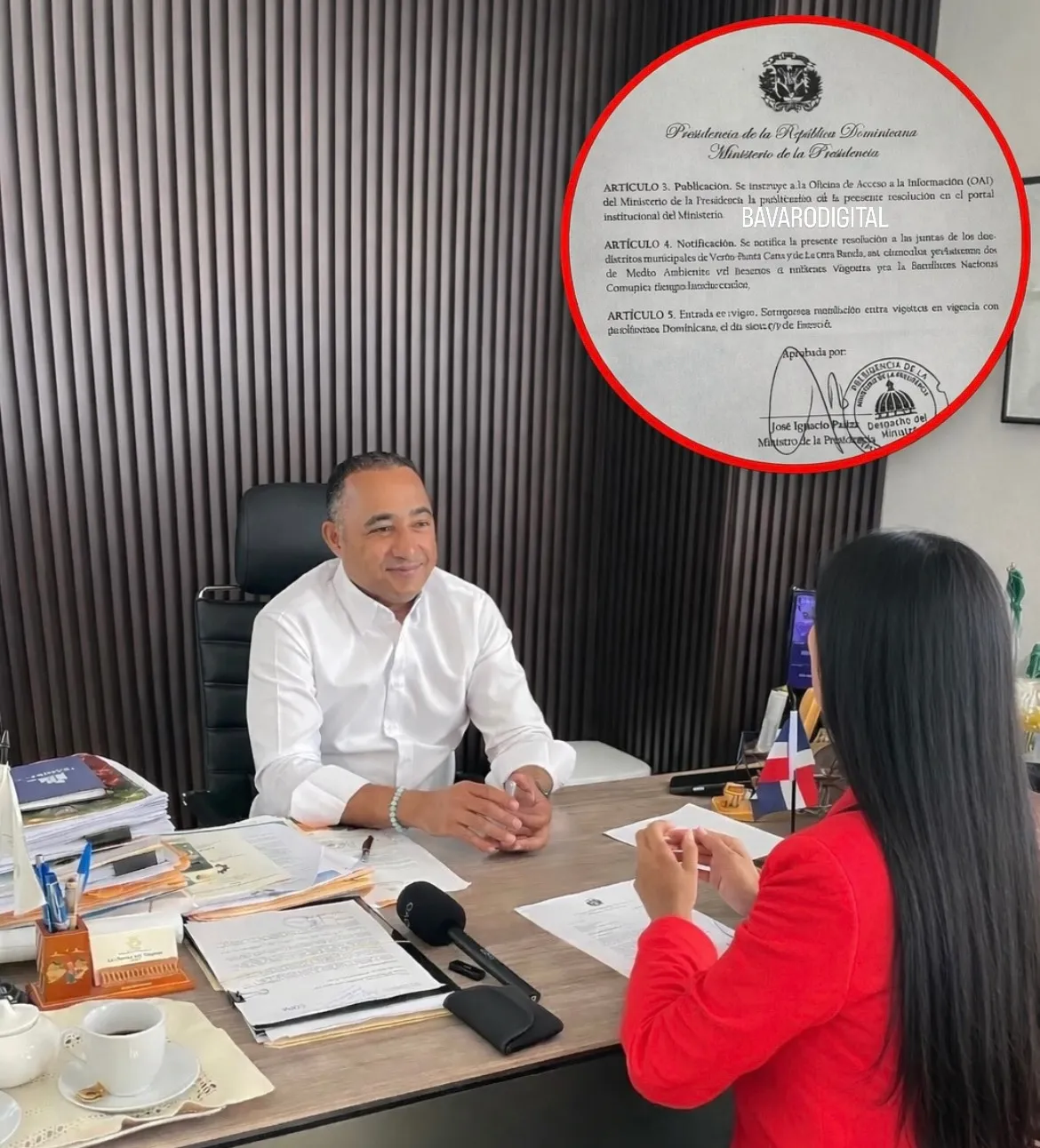
Verón, Punta Cana.— The mayor of the Verón–Punta Cana Municipal District, Ramón Antonio Ramírez “Manolito,” affirmed that the recent authorization allowing the district to manage its own land use is not the result of luck, pressure, or improvisation. Instead, he described it as the culmination of nearly a decade of institutional work, legal battles, and legislative advocacy that began in 2016 in pursuit of greater territorial autonomy.
In an exclusive interview with Bávaro Digital, the mayor explained that the approval represents a milestone achieved only after multiple rounds of technical evaluations, formal proposals, congressional discussions, and judicial processes. He stressed that Verón–Punta Cana had to demonstrate full compliance with the national requirements established for municipalities seeking land‑use control.
A Legal Turning Point: Law 368‑22 and Article 24
Manolito detailed that the process gained decisive momentum with the inclusion of Article 24 of Law 368‑22, the national law governing territorial planning, land use, and human settlements. According to the mayor, this article—initially backed by former legislator Félix Bautista—was shaped with input from Verón–Punta Cana, setting the legal framework that later enabled qualified municipal districts to request land‑use authority.
He added that, once the proposal reached Congress, the initiative received crucial support from various sectors, resulting in legislation that clearly outlines which municipal districts can assume this responsibility and under what conditions.
A Favorable Ruling Strengthens the Case
Another decisive moment came when the Superior Administrative Court (TSA) issued a favorable decision for Verón–Punta Cana. Manolito emphasized that this ruling significantly strengthened the district’s legal position and reinforced the district’s claim to manage its own territorial planning.
He noted that the entire process is additionally protected by the Dominican Constitution, which establishes the legitimacy and legal foundation for municipal autonomy.
25 Municipal Districts Applied — Only Two Qualified
The mayor clarified that granting land‑use authority was not an exclusive request made by Verón–Punta Cana or La Otra Banda. In total, 25 municipal districts across the country submitted applications to assume responsibility for managing land use.
However, after evaluating all submissions, only Verón–Punta Cana and La Otra Banda met the technical, legal, and socioeconomic criteria required by national regulations.
“The qualification doesn’t depend solely on population size,” the mayor said. “There must also be a socioeconomic study proving that the district has the real capacity — and the necessary institutions — to assume this responsibility.”
A Historic Step Toward Autonomy and Territorial Order
With the official authorization now granted, Manolito considers this a profound victory for the district — and one achieved through consistent, sustained effort. He reiterated that Verón–Punta Cana already has the trained personnel, technical infrastructure, and administrative readiness to manage land use directly.
“This marks a new stage for Verón–Punta Cana,” he concluded. “It represents a stronger, more autonomous district capable of organizing its own territory and guiding its future development.”
