
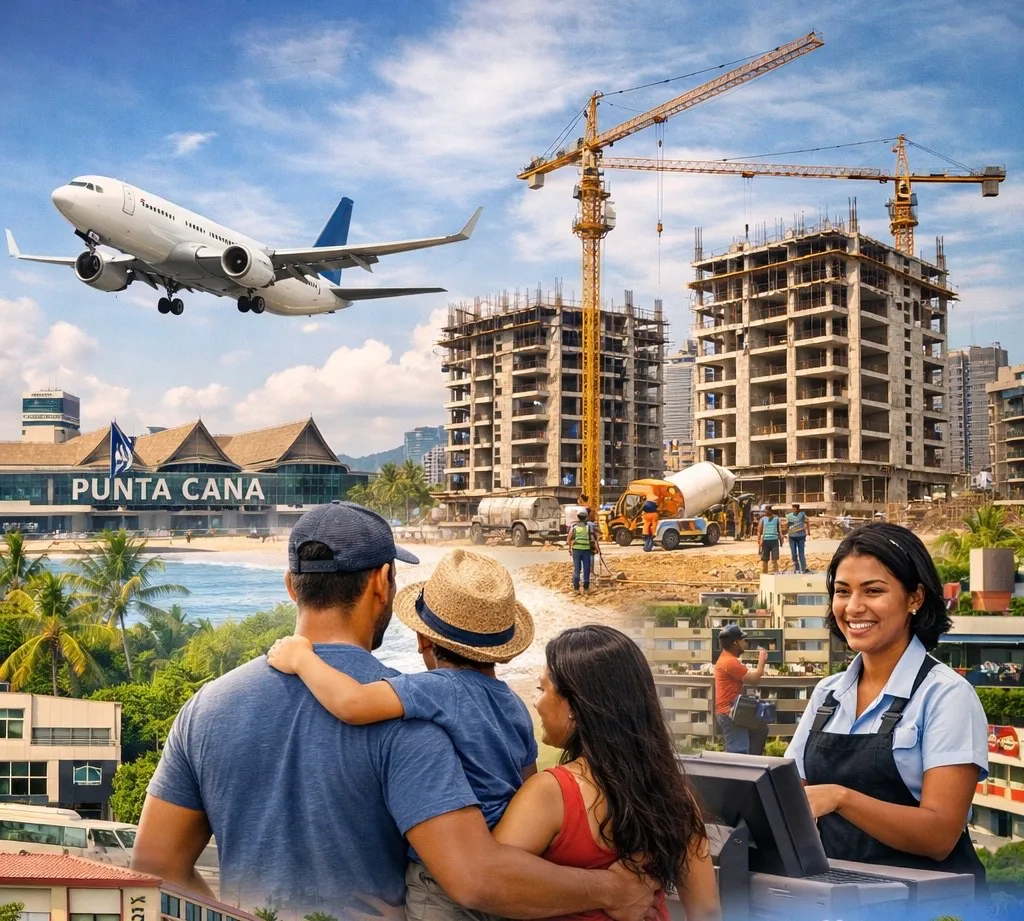
Bávaro, Verón, and Punta Cana stopped being “just a strip of hotels” years ago. Today, this area operates as a rapidly expanding urban center, drawing in jobs, capital, services, and—most importantly—entire families looking to build a future. What once functioned solely as a vacation hotspot has evolved into a thriving, multifaceted city with a pace of growth visible in new businesses, residential complexes, and a steady influx of people chasing better opportunities.
1. Jobs Are the Main Magnet (And Where Jobs Go, Cities Follow)
The primary driver is straightforward and timeless: employment.
Tourism powers an enormous economic chain that includes hotels, restaurants, transportation, construction, maintenance, security, event planning, suppliers, logistics, retail—the list is nearly endless.
This engine runs on a constant stream of international visitors. Between January and June 2025, Punta Cana International Airport handled 72.9% of all non-resident foreign arrivals by air in the Dominican Republic—2,789,430 passengers—and the numbers continue to grow year over year.
With hotels operating at full capacity, the Punta Cana and Bávaro area posted an impressive 85.8% occupancy rate during the same period.
For Dominicans across the country, the message is clear: “You can find work here faster than almost anywhere else.”
2. Internal Migration: The “Strategic Relocation” from Cities and Towns
People don’t uproot their lives on a whim (though some might do it for the Instagram aesthetic). They move for higher income, better opportunities, and a tangible sense of progress.
In local media and urban development reports, Verón–Punta Cana is frequently cited as one of the fastest-growing population centers in the entire country, facing real and mounting pressure on public services, infrastructure, and urban planning.
3. Construction and Real Estate: The Silent Job Creator
The investment boom has triggered another powerful magnet: construction.
And construction doesn’t just mean direct jobs on building sites—it also generates a ripple effect of related employment: hardware stores, equipment rentals, food vendors, transportation services, security firms, and more.
But there’s a trade-off: the same boom that attracts workers also drives up the cost of living. Market reports indicate rising rents and increasing price pressure in areas throughout Punta Cana, making affordability a growing concern for many residents.
4. Services and Lifestyle: From “I’m Here to Work” to “I’m Here to Stay”
A decade ago, the typical story was: “I’m coming for the season, then heading back home.”
Now, more and more people are saying: “I’m putting down roots.”
Why the shift?
- More retail options: supermarkets, pharmacies, and shopping centers
- Better healthcare and education: clinics, private schools, and training centers
- Expanded leisure and dining: gyms, restaurants, entertainment venues (and yes, more traffic too)
- A partially dollarized economy in certain zones, which attracts those looking to earn in stronger currency or increase their purchasing power
The area is no longer just a place to work—it’s becoming a place to live a full life.
5. The “Hub Effect”: Connectivity Attracts Everything Else
When a location dominates air connectivity, it naturally becomes a regional hub.
If Punta Cana is receiving the majority of the country’s international air arrivals, that’s not just about tourism—it’s about routes, jobs, investment, services, logistics, and global reputation.
This connectivity effect turns Punta Cana into a gateway not just for tourists, but for commerce, culture, and opportunity.
6. The Uncomfortable Reality: Rapid Growth = Social Pressure
A city growing at this speed inevitably pays a price:
- Higher rents and housing competition, squeezing out lower-income residents
- Strain on infrastructure: water, electricity, healthcare, education, and traffic systems
- Visible inequality: luxury resorts and high-end developments exist side-by-side with labor camps and migrant vulnerability—a reality already documented in international reports on the region
This doesn’t invalidate the progress. What it does demand is serious, long-term urban planning—not quick fixes rolled out every high season.
The Bottom Line: Bávaro–Verón–Punta Cana Is Becoming a Real City
Dominicans are moving to Bávaro, Verón, and Punta Cana in growing numbers due to a powerful combination of factors: employment opportunities, investment activity, air connectivity, and genuine urbanization.
It’s the classic pattern of cities that emerge around a major economic engine—except here, that engine is international tourism operating at industrial scale.
And the challenge moving into 2026 and beyond is crystal clear: the area must transition from being seen as a “tourist destination” to being managed as a well-governed city.
Because when a place has more than 140,000 residents, it can no longer be run like a neighborhood. It needs to be governed like what it truly is: a city.
