
Four ingredients Dominicans think are Taíno, and are not
The plantain that defines the Dominican plato del día reached the island in 1516, the same century the first enslaved Africans arrived, brought from the Canary Islands by a Spanish friar. Before that date, no Taíno had ever tasted a plantain. And the plantain is not alone: of the ingredients Dominican cooking treats as its own, at least three more arrived by equally distant routes.
Victor Matos September 6, 2026
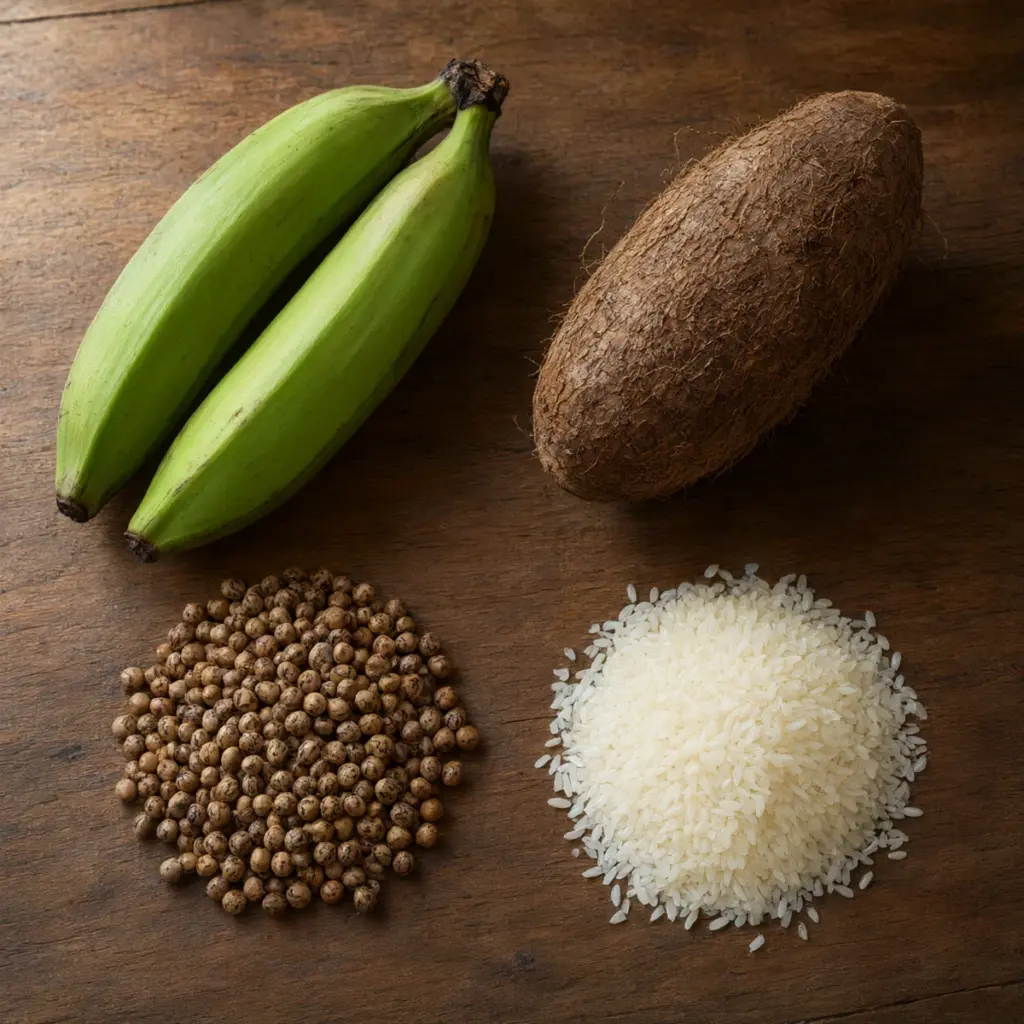
The plantain that defines the Dominican plato del día reached the island in 1516, the same century the first enslaved Africans arrived, brought from the Canary Islands by a Spanish friar. Before that date, no Taíno had ever tasted a plantain. And the plantain is not alone: of the ingredients Dominican cooking treats as its own, at least three more arrived by equally distant routes.
Plantain: from New Guinea to the Canaries, and to Hispaniola in 1516
The genus Musa originated in Southeast Asia, probably in the Kuk valley of Papua New Guinea. Plantains were already traded in the Canary Islands before 1516, when fray Tomás de Berlanga brought the plant to Hispaniola, the first documented record of it in the western hemisphere. Within a decade plantations were supplying between 500 and 1,000 bunches per galleon to Spanish fleets as anti scurvy provisions.
Ñame: from Asia to the Caribbean along the slave trade route
The ñame grown in Dominican fields today (Dioscorea alata) was domesticated in Southeast Asia. Its genetic stock passed first to Africa, and from a Portuguese trading post at São Tomé, in the Gulf of Guinea, it was introduced to the Caribbean in the late 16th century, along the same route as the trade in enslaved people. It arrived more than a century after corn and cassava were already established on the island. It should not be confused with batata, which is American and precolumbian.
Pigeon peas: domesticated in India 3,500 years ago
Moro de guandules, an identity dish, carries in its name a legume whose journey began in central India, where it was domesticated from its wild progenitor about 3,500 years ago. It spread first to Africa, documented in Egyptian tombs around 2200 BC, and from there reached the Americas on the ships of the slave trade. The English name pigeon pea is documented in the British Antilles from 1692.
Rice: two continents of origin, neither American
The most consumed food in the country, the base of la bandera, has two roots rather than one. One variety, Oryza sativa, came on Spanish ships from Asia by way of the Philippines from the 16th century. The other, Oryza glaberrima, crossed the Atlantic as provisions on slave ships, domesticated 3,500 years ago on the banks of the Niger river in Mali, and later grown by enslaved people in their own plots.
What actually is native
Of the central ingredients of this cooking, only corn and peanut are genuinely precolumbian: their presence on the island before 1492 is confirmed by DNA recovered from coprolites at La Hueca-Sorcé, Vieques, Puerto Rico, dated between 245 and 600 AD.
Sources
- Plantain: “Plantain of Guinea: The Atlantic Adventure of Banana”. researchgate.net
- Ñame: peer reviewed genomic study of Dioscorea alata. ncbi.nlm.nih.gov
- Pigeon peas: Winrock International / CGIAR Genebanks. winrock.org
- African rice: “African Rice”, peer reviewed. pmc.ncbi.nlm.nih.gov
- Corn and peanut in Vieques coprolites. pmc.ncbi.nlm.nih.gov