
The six seasonings in Dominican sofrito and where they really come from
Columbus crossed the Atlantic looking for black pepper, the Asian spice that by the 15th century sold for close to its weight in gold in Europe, and on reaching Hispaniola he found the Taíno ají instead. Because of that confusion we still call a fruit with no botanical relation to true pepper a pimiento. Dominican sofrito rests on six ingredients, and their real history is not what the finished flavor suggests: three are American, the other three crossed half the planet.
Victor Matos September 6, 2026
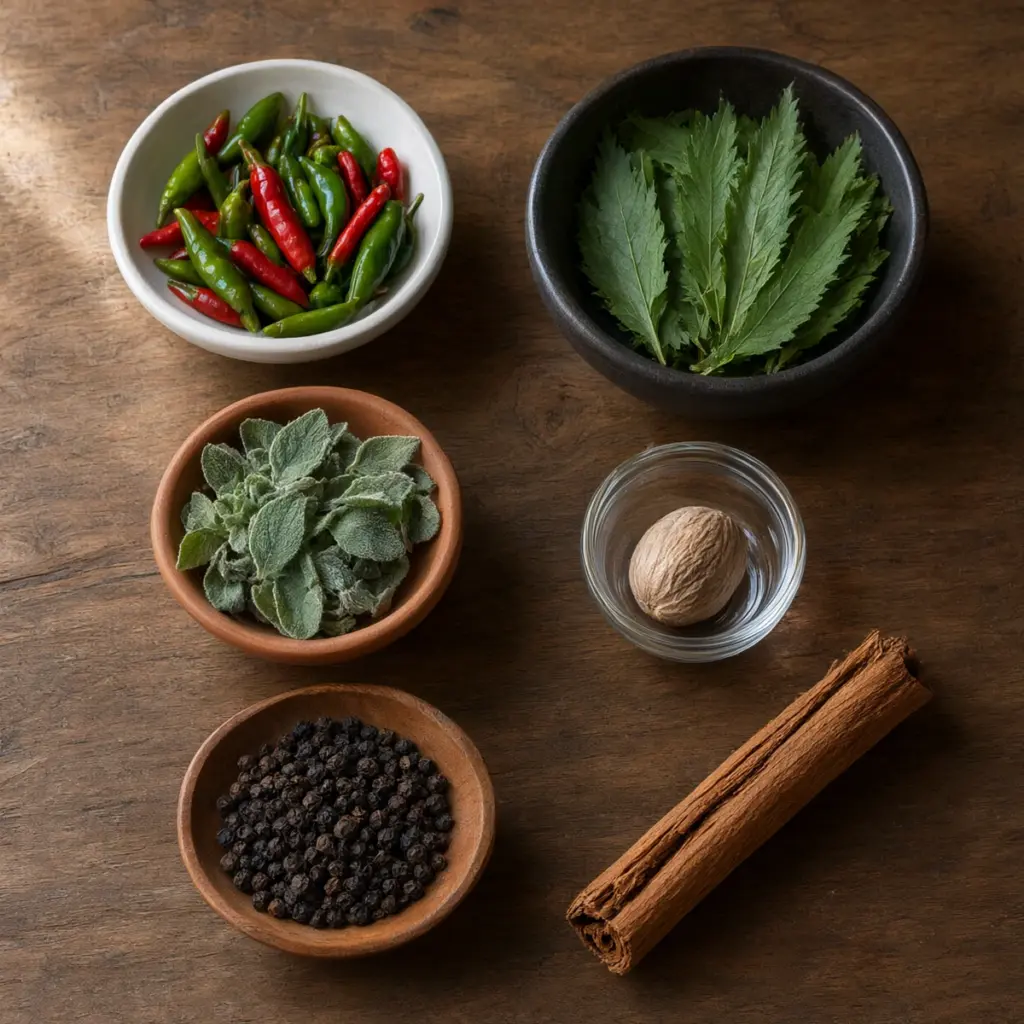
Columbus crossed the Atlantic looking for black pepper, the Asian spice that by the 15th century sold for close to its weight in gold in Europe, and on reaching Hispaniola he found the Taíno ají instead. Because of that confusion we still call a fruit with no botanical relation to true pepper a pimiento. Dominican sofrito rests on six ingredients, and their real history is not what the finished flavor suggests: three are American, the other three crossed half the planet.
Ají cubanela: American, but not Caribbean in origin
Capsicum annuum, domesticated in Mesoamerica, not in the Caribbean. The genus reached the Antilles before 1492 through human migration from the lower Orinoco by way of Trinidad. The first written European record is the letter of Dr. Diego Álvarez Chanca, physician on Columbus’s second voyage in 1493-94, describing the “axí” among the island’s edible plants. The name cubanela is much later, and no academic source documents when or why it was adopted.
Cilantro ancho: not the coriander sold in Europe
What is called cilantro ancho in the Dominican Republic is not Coriandrum sativum, European coriander. It is Eryngium foetidum, a botanically distinct species native to tropical America that Dominicans have cooked with since before Columbus arrived. European coriander is indeed from the eastern Mediterranean and came with colonization, but it is not the one in the sofrito.
Fresh oregano: from Africa, by way of Asia, wrongly called Cuban
The thick aromatic leaf many Dominican kitchens simply call oregano is not related to dried Mediterranean oregano. It is Plectranthus amboinicus, native to southern and eastern Africa, which traveled first to Asia along Indian Ocean trade routes before reaching a creole sofrito centuries later. It is not Cuban either, despite its most common name. No source documents the date or route of its arrival on Hispaniola.
Cinnamon, nutmeg and black pepper: the three Asian ones
Cinnamon (Cinnamomum verum) is native to Sri Lanka; the Portuguese controlled its trade from 1518. Nutmeg (Myristica fragrans) grew, until the 19th century, only on a handful of Indonesian islands, the Banda islands, whose control cost a colonial massacre in 1621. And black pepper (Piper nigrum), from Kerala in southern India, was the original economic objective of Columbus’s voyage. All three reached Hispaniola through the same circuit: Iberian trade toward Seville and, in parallel, the Manila Galleon from 1565.
Sources
- Ají: RIVAR, peer reviewed. scielo.cl
- Cilantro ancho: peer reviewed review of Eryngium foetidum. ncbi.nlm.nih.gov · Purdue University. hort.purdue.edu
- Oregano: TRAMIL, Caribbean academic network. tramil.net
- Cinnamon: Sri Lanka Export Development Board. srilankabusiness.com
- Nutmeg: World History Encyclopedia. worldhistory.org
- Colonial routes: SciELO Mexico. scielo.org.mx