
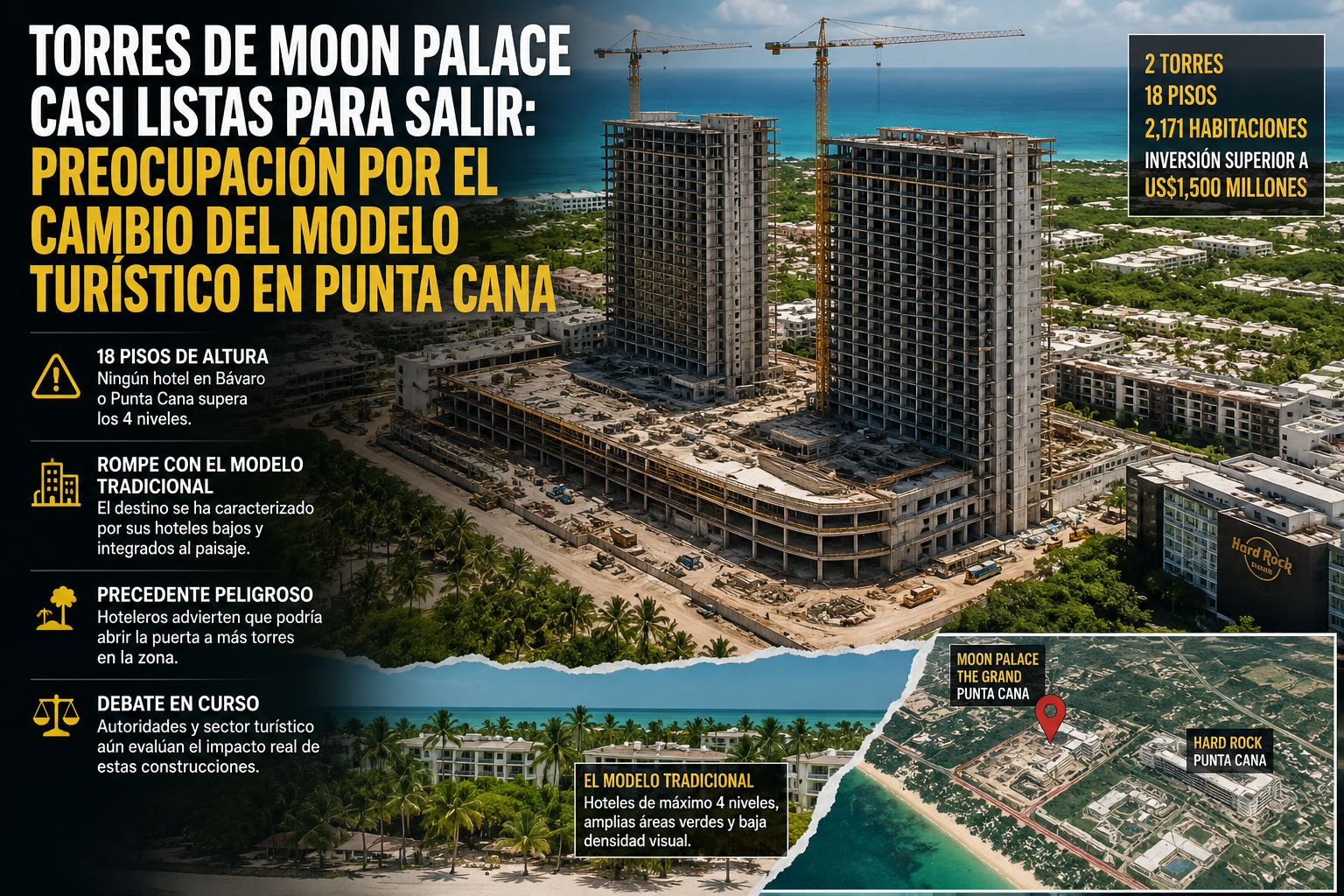
PUNTA CANA — Construction of the Moon Palace The Grand Punta Cana project in the Macao area, near Hard Rock Punta Cana, is approaching its final stages, with the massive complex now visibly reshaping the local skyline. But alongside the progress of the project has come a renewed debate in tourism and urban planning circles: is the low-rise model that helped make Bávaro-Punta Cana one of the Caribbean’s most successful destinations beginning to give way to a new era of vertical development?
Developed by The Palace Company, the project includes two 18-story towers with more than 2,000 rooms, an unprecedented scale for an area long defined by horizontal hotel design, broad green spaces and low-density construction.
For decades, Punta Cana and Bávaro built their tourism identity around a very specific image: low-rise hotels surrounded by vegetation, open landscapes, clear beaches and a horizon dominated by palm trees and nature. That model helped distinguish the destination from others such as Cancun or Miami Beach, where large oceanfront buildings are more common.
Today, the towers at Moon Palace The Grand Punta Cana represent one of the most dramatic visual changes the area has seen in recent years.
The controversy surrounding the project is not new. From its earliest stages, the development drew questions from sectors linked to the tourism industry, as well as from authorities and investors concerned about the approval of high-rise construction in a zone traditionally characterized by low buildings.
For many observers, the discussion has never centered only on a hotel project. The broader concern is the precedent it could set. If an 18-story tower is authorized today, other developers may seek similar approvals tomorrow. That is where the core of the debate lies: not only in what Moon Palace is building, but in what it may mean for Punta Cana’s future urban model.
One of Punta Cana’s greatest attractions has always been its open, natural landscape. The new towers introduce a very different silhouette — one visible from long distances and capable of altering the traditional profile of the resort corridor.
Supporters of the project argue that vertical construction brings important advantages. They say it allows more rooms to be concentrated on less land, preserving green areas and reducing horizontal sprawl. The company has also pointed to landscaping and mangrove protection measures as part of the development’s planning.
Critics, however, say that efficient land use is one issue, while changing the visual identity that has defined the destination for decades is another. For them, Punta Cana’s appeal lies precisely in its low-impact, nature-integrated model — and that essence could be at risk if vertical growth becomes the norm.
There is little dispute over the economic weight of a project of this size. Moon Palace The Grand Punta Cana is expected to generate thousands of direct and indirect jobs, add a significant number of hotel rooms and expand the area’s luxury tourism offering with restaurants, swimming pools, entertainment facilities and a major convention center.
Still, industry voices note that Punta Cana’s success was not accidental. It was the result of a combination of planning, private investment, landscape preservation and an internationally recognized tourism brand built around leisure and beachfront experiences.
The challenge, they say, is finding a balance between growth and preservation. Rapid development can bring immediate economic benefits, but it can also leave lasting consequences for a destination’s image and long-term competitiveness.
The central question now is whether these towers will remain an exception or mark the beginning of a new phase of vertical construction in eastern Dominican Republic.
If the project stands alone, it may simply become one more element in a diversified tourism model. But if it opens the door to more developments of similar scale, Bávaro-Punta Cana could see a profound transformation in both its landscape and its tourism identity.
For authorities, the task will be to ensure that growth continues without losing sight of land-use planning, environmental sustainability and the vision that turned Punta Cana into a global tourism benchmark.
The debate is no longer theoretical. With the towers now visible from different points in the area, the question is not whether the project will be built.
It already is.
The real issue now is what kind of destination Punta Cana wants to be 20 years from now.
A tower can symbolize development, investment and modernity. But many believe that unchecked vertical expansion could alter precisely what made this destination unique in the first place.
And in tourism, losing identity can be far more costly than building an 18-story tower.
