
Punta Cana is building the plumbing, the parks, and the conscience it was always accused of lacking
Punta Cana infrastructure is no longer being improvised by developers racing to pour concrete before the next tourist season; it is being engineered by a city that has finally decided to govern its own future. I say this knowing how it sounds, knowing that half the people reading this column from their balconies in Cap Cana or their desks in Santo Domingo will roll their eyes at the suggestion that our growth has ever been anything other than a beautiful accident, a happy collision of foreign capital and Caribbean sand. But look at what happened this week. Look at the water we are about to reuse, the coastline we are about to regulate, and the children we are beginning to see. Am I wrong? Maybe. But then explain to me why a district once defined entirely by what it could sell to a visitor is now, quietly and without asking anyone’s permission, building the unglamorous machinery of a real civilization. We are not just adding rooms anymore. We are laying the pipes, drawing the maps, and opening the doors that make a destination into a place where human beings actually live.
Aurelio Nicéforo Beltré September 12, 2026
The water that returns instead of disappearing
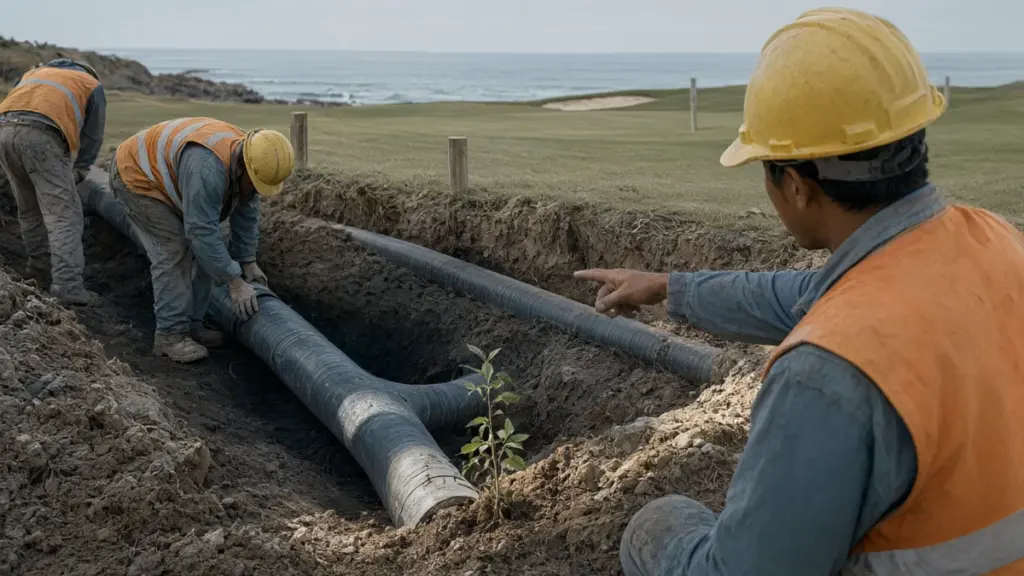
I stood near the edge of Verón yesterday afternoon, where the heat does not merely rise but presses down on your shoulders like a physical weight, thick with the smell of wet earth and diesel exhaust, watching a convoy of heavy yellow machines — those slow-moving iron beasts with articulated arms that dig trenches deep enough to swallow a man whole — tear open the red dirt along the main road. They were laying pipe for the new aqueduct. And while most people driving past saw only another traffic delay, another cloud of laterite dust coating their windshields, the director of INAPA confirmed something that changes the fundamental arithmetic of our survival here: the treated water coming out of the Punta Cana sanitation project will not be dumped into the sea or left to evaporate in some forgotten lagoon. It will be reused for landscaping and gardening across the zone.
You might think this is a minor technical detail, the sort of thing discussed in municipal meetings where everyone checks their watch. You would be wrong. For years, the criticism leveled against us — and I have sat in this office listening to it echo through every editorial page in the country — was that our model extracted everything and returned nothing. That we drank the aquifer dry to fill infinity pools, that we treated the underground rivers as an infinite credit line with no maturity date. The skeptics built entire careers predicting our ecological collapse, standing behind podiums in air-conditioned conference rooms far from here, pointing at charts that showed our water table dropping like a stone thrown into a well. They were not entirely wrong to worry. A city that grows this fast, that pulls millions of bodies through its airport every year, each one expecting a cold shower and a green lawn upon arrival, is playing a dangerous game with hydrology.
But here is the complication, the thing that forces you to rethink the narrative of inevitable ruin. The engineers working on this sanitation system are not just moving waste away from the resorts; they are closing the loop. By treating the water and routing it back into the irrigation systems of the very hotels and residential complexes that consumed it, they are doing something that older, supposedly more mature cities in the Americas still refuse to do. Think about it. We are building a circular water economy in a tropical district that did not even have a proper municipal government a few decades ago. Is it perfect? No. Will there be leaks, bureaucratic delays, and contractors who cut corners? Of course. There is always someone willing to substitute a cheaper valve when the inspector is looking the other way. But the architecture of the project itself represents a philosophical shift so profound it makes the old arguments about unsustainable tourism sound like echoes from a century we have already left behind.
I watched the trenching machines bite into the soil again today, their steel teeth lifting heavy clods of red clay that steamed in the midday sun, and I thought about what it means to build something that gives back. Not metaphorically. Literally. The water that washes the sheets in a five-star resort will, after passing through a series of biological and mechanical filters — those humming concrete basins where bacteria do the quiet work of purification — return to nourish the palm trees lining the boulevard. This is not charity. It is engineering driven by necessity, yes, but necessity is the mother of every great urban innovation. When you run out of options, you stop wasting things. Punta Cana ran out of the luxury of waste faster than anyone predicted, and instead of collapsing, we started designing.
This is what the skeptics miss when they fly in for a weekend, take photographs of a construction site, and write their dire prophecies. They see the consumption but they do not see the correction. They do not see the blueprints. The reuse of treated water is not just an environmental policy; it is a declaration of permanence. A temporary resort town flushes and forgets. A city builds a system that remembers. And as those yellow machines continue their slow, grinding march down the avenues of Verón, cutting scars into the earth that will soon carry the lifeblood of our landscapes back to where it belongs, I feel something I rarely feel when reading government press releases. I feel the solid, undeniable weight of a place that intends to be here tomorrow.
A map drawn by technicians, not by speculators
If water is the blood of a city, zoning is its skeleton, and for too long, our skeleton was assembled in the dark, by hands that cared more about square meters than sightlines. This week, a team of specialists in territorial planning and municipal management walked the dusty, unpaved perimeters of El Salado. They were not developers looking for the best angle to pitch a high-rise. They were conducting a technical survey, measuring elevations, noting drainage patterns, cataloging the reality of the ground so they could deliver a formal report to the Ayuntamiento. Their goal? To force a reevaluation of the land classification that has governed this area, a classification that everyone living here knows was drawn up in a hurry, under pressure, by people who had never walked the terrain they were dividing into parcels.
I know what you are thinking. You are thinking about the tribunal order that just suspended the eviction of COOPFVIESTE from fourteen thousand square meters of public land right here in Bávaro. You are thinking about the families living on terrain that legally belongs to the state, caught in a web of cooperative promises and judicial injunctions. You are thinking that any talk of “territorial ordering” in a place where courts have to pause bulldozers to protect vulnerable communities is just another word for displacement dressed up in bureaucratic language. And I cannot dismiss that fear. I have lived through enough evictions, enough sudden appearances of men in hard hats carrying rolled-up plans that erase entire neighborhoods overnight, to know that when the government starts talking about “reclassifying soil,” the people living on that soil start packing their bags. The shadow of the bulldozer is long in the Dominican Republic.
But am I wrong to see something different happening in El Salado? Perhaps. But then explain to me why the approach this time feels fundamentally altered. The technicians who walked the land this week were not sent by a private consortium trying to clear title for a golf course. They were deployed to gather data for the municipal council, to provide the elected officials — the regidores who actually have to face the voters — with the empirical evidence needed to correct past mistakes. This is the difference between a land grab and a land plan. One operates in secrecy; the other requires a survey. The fact that the classification of El Salado has generated “questioning” within the territorial ordering process means the process is actually functioning. A flawed map that is being openly questioned and corrected is infinitely better than a flawless map that exists only in the mind of a speculator.
I drove out toward El Salado yesterday evening, just as the light was turning that bruised purple color it takes on before the coastal rains arrive. The landscape there is not the manicured illusion of the hotel zone. It is raw, uneven, dotted with small concrete block houses and tall grass that hisses when the trade winds push through it. It is a place where people live, not just visit. And the idea that a team of experts is walking that grass, taking measurements, trying to figure out how to integrate it into a coherent municipal grid rather than simply erasing it, suggests a maturation in our governance that we desperately need. Urban planning in the tropics is a brutal discipline. The rain does not care about your property lines. The runoff goes where gravity tells it to go. If you classify a floodplain as residential because someone paid a fee at a desk in the capital, you are not building a city; you are engineering a disaster.
This technical survey is the unglamorous, tedious, absolutely essential work of making Punta Cana a real place. It lacks the romance of a new resort opening or a celebrity sighting on the beach. No one writes songs about soil classification matrices. But without it, the towers those steel arms rotate slowly over the concrete skeletons to build — lifting heavy beams against the afternoon sky while the welders’ sparks fall like brief, dying stars — will eventually stand on ground that cannot support them. The Ayuntamiento receiving this survey is not just getting a document. They are receiving the tools to govern. And if they use those tools to protect the residents of places like El Salado while organizing the growth around them, then the suspension of that eviction in Bávaro isn’t a sign of legal chaos. It is a sign that the law is finally catching up to the concrete.
The shoreline we are learning to hold gently
There is a specific quality to the light at El Cortecito in the late morning, a sharp, blinding reflection off the shallow turquoise water that forces you to squint even when you are standing in the shade of a sea grape tree. It was in this light that the Vice Minister of Tourism, Carlos Peguero, alongside Senator Rafael Barón Duluc, walked the beach this week. They were not there to cut a ribbon or pose for a photograph. They were there to evaluate the conditions of the coast and advance a regulatory framework to organize, protect, and improve one of the most important tourist environments in the Caribbean. They looked at the vendors, the placement of the chairs, the erosion lines, the friction between commerce and nature. They looked at the mess we have made of paradise, and instead of looking away, they took notes.
For years, El Cortecito has existed in a state of beautiful, chaotic tension. It is the place where the polished world of all-inclusive luxury collides directly with the entrepreneurial hustle of the local economy. You step off the resort property and suddenly you are navigating a labyrinth of craft sellers, massage tables, hair braiders, and excursion touts, all operating on a strip of sand that belongs to everyone and therefore, historically, to no one. The purists — usually writing from comfortable offices in Europe or North America — argue that this chaos ruins the pristine aesthetic. The locals argue that this chaos is their livelihood, their right, their share of the tourism pie. Both are right. Both are wrong. The result has been a shoreline that feels simultaneously vibrant and exhausted, a place where the sheer density of human ambition threatens to crush the very natural beauty that attracts the ambition in the first place.
So when the Ministry of Tourism sends its leadership to walk the sand, the immediate reaction from the vendors is terror. I understand it. Regulation, in our history, has often meant eradication. It has meant men in uniforms telling a woman who has sold coconuts on the same corner for fifteen years that her wooden cart violates a new municipal code she has never seen. Why should they trust this visit? Why should I trust it? Because I am tired of pretending that doing nothing is a form of protection. Leaving El Cortecito unregulated hasn’t preserved its authenticity; it has subjected it to the tyranny of whoever is loudest, whoever claims the most space, whoever is willing to push their plastic chairs closest to the tide line until the ocean itself pushes back. A beach cannot survive as a free-for-all. Sand is finite. Shade is finite. Patience is finite.
What struck me about this visit was the language used by the authorities. They spoke of “ordering and protecting,” not “clearing and sanitizing.” They observed the dynamics. They walked among the people who actually work the beach. This matters. You cannot regulate a space you refuse to enter. The attempt to create a framework that accommodates both the visitor’s desire for tranquility and the resident’s need for income is the hardest puzzle in Caribbean tourism. It requires a precision that brute force cannot achieve. It requires understanding that the woman selling painted shells is not an obstruction to the tourist experience; she is part of it, provided she has a designated place to stand that doesn’t block the coastal breeze or damage the dune vegetation.
We are attempting something unprecedented here. We are trying to retrofit urban planning onto a beach culture that evolved organically over three decades of explosive growth. It will be messy. There will be arguments. Someone will inevitably claim they are being unfairly targeted while their neighbor gets to stay. But the act of walking the beach with a clipboard and a mandate to protect, rather than a bulldozer and a mandate to clear, is the mark of a destination that has grown up. El Cortecito is not just a postcard. It is a workplace, a living room, a frontline. Treating it with the seriousness of a regulatory challenge, rather than the annoyance of a visual nuisance, proves my thesis: we are done improvising. We are finally building the rules to match the reality we created.
Punta Cana infrastructure as social conscience
I told myself I would stick to the concrete facts — the pipes, the surveys, the regulations — because sentimentality is the enemy of serious analysis. But then I read about the PGA TOUR players sitting down with Ziara Betancourt, a young girl receiving care at the Centro de la Diversidad Infantil Puntacana (CEDI). I read about professional athletes, men whose bodies are insured for millions, whose lives are measured in strokes and prize money, spending their time not on the manicured fairways where they are expected to perform, but in a room with a child who needs them to simply be present. And I realized that if I leave this out, I am lying about what is happening in this city. Because Punta Cana infrastructure is not just concrete and water. Infrastructure is also the social architecture that determines whether a place has a soul or merely a gross domestic product.
You expect this of us now, don’t you? You expect the cynicism. You expect me to say it was a photo opportunity, a corporate social responsibility checkbox ticked by tournament organizers eager to soften the optics of flying hundreds of people to an island to hit a ball into a hole. I have written those columns before. I have mocked the hollow philanthropy of industries that give back a fraction of what they extract. But sit with this for a moment. Strip away the logos and the cameras. Look at the geometry of the encounter. A global sporting apparatus, generating massive revenue in our district, pausing its machinery to interface with a local institution dedicated to children with diverse needs. CEDI does not exist to serve tourists. It exists to serve us. The fact that the international spotlight of professional golf was directed inward, toward our own vulnerable population, suggests a shifting center of gravity.
Am I projecting too much meaning onto a single afternoon? Perhaps. A child smiling with a golfer does not fix the systemic inequalities of a tourism-dependent economy. It does not lower the cost of medicine or guarantee a wheelchair ramp on every sidewalk in Bávaro. I am not a fool. I know the difference between a gesture and a structural reform. But gestures, when repeated, become culture. And culture dictates what a society demands of its institutions. Twenty years ago, the interaction between the global elite who visited Punta Cana and the local community was strictly transactional. You served the drink; they drank it. You cleaned the room; they slept in it. The wall between the resort and the reality was absolute. What happened at CEDI this week was a crack in that wall. Not a demolition, but a fracture through which light is entering.
I think about the women who gathered earlier this month at Le Club Rubis in Bávaro, painting their dreams on canvas in a workshop designed to let them envision the lives they want. I think about Playa Bávaro being recognized globally not just for its sand, but as a premier destination for water sports, a place where the ocean is engaged with, not just looked at. These are not isolated events. They are symptoms of a place that is diversifying its identity. We are no longer content to be merely a backdrop for someone else’s vacation. We are becoming the authors of our own narrative. The golfers visiting CEDI did not come to save us. They came to participate in a community that is increasingly demanding participation from those who profit from its geography. Just as our ongoing coverage of Punta Cana’s water management reveals the hidden engineering beneath our streets, these social investments reveal the hidden architecture of our civic life.
This is the final piece of the argument, the element that binds the water pipes to the zoning maps to the protected beaches. A city that only builds for profit will eventually be destroyed by its own greed. But a city that begins to route its water back into its own gardens, that measures its land to protect its residents, that regulates its shores to preserve its nature, and that invites its wealthiest visitors to look into the eyes of its most vulnerable children — that city is doing something much harder than growing. It is maturing. Punta Cana is no longer apologizing for its existence, nor is it blindly celebrating its expansion. It is, finally, thinking. And a city that thinks is a city that survives. For those tracking the broader economic shifts driving these changes, the latest reports on Dominican Republic tourism growth confirm what we can already see from our windows: the foundation is holding.